How to Know Who Gave You Hiv
Recently, Georgia lawmaker Betty Price sparked controversy by wondering whether people with human immunodeficiency virus (HIV) could be put in quarantine to adjourn the infectious disease'southward spread. The backlash was swift—not surprising, considering the comments' stigmatizing implications—only information technology besides highlighted some of the prevailing myths almost the affliction.
On a basic level, most of the states are familiar with HIV, the virus that can progress to AIDS. HIV attacks your body's immune arrangement, especially your CD4 cells, which are vital to helping your trunk fight off infection. The virus can reduce the number of those infection-fighting cells, making you more vulnerable to certain infections and affliction, according to the Centers for Disease Control and Prevention (CDC).
In 2010, the well-nigh contempo twelvemonth for which new HIV infection data is bachelor, 38,000 men received an HIV diagnosis in the U.Due south. While HIV cases are on the decline in full general, it'south nonetheless a serious trouble, particularly in sure groups. For instance, gay and bisexual men deemed for seventy percent of all new HIV infections in 2014, co-ordinate to the CDC. And some racial groups are more heavily afflicted, likewise, particularly African American and Hispanic. In fact, African Americans make up 12 pct of the U.S. population, but account for 45 percent of all new HIV diagnoses.
HIV has been in the public center since the early 1980s, and since that fourth dimension, misconceptions nigh the disease accept abounded. Price's comments only emphasize the importance of getting the real facts out to the public, says Carlos Malvestutto, Grand.D., G.P.H, who specializes in infectious disease at Ohio State University Wexner Medical Center.
"There are definitely misperceptions that seem to have a surprising amount of staying power," he says.
Here are 8 myths about HIV that have lingered, and the truths that should dispel them for good. (And for more health news delivered right to your inbox, sign upward for our Daily Dose newsletter.)
HIV Myth: Transmission is e'er a high risk from people with HIV

For decades, this was really true.
"There'southward a reason they called it an epidemic," says Dr. Malvestutto. "Only we've come a very long manner since the 1980s in terms of learning how to control transmission."
But with new medical advances like antiretrovirals, which lower the level of HIV in your body—known as the viral load—it's but not the case anymore. In fact, at that place's a catchy mnemonic in the communicable diseases world now: U=U. If your HIV is undetectable—significant the viral load is low plenty so information technology doesn't prove up on blood tests—then it's very unlikely to be transmitted.
"There are numerous studies to support this, and the CDC supports this, considering the data is consequent," Dr. Malvestutto says. "So, although we still encourage safety utilise to forestall other STDs, the risk of HIV is just not there if the prophylactic breaks."
In fact, co-ordinate to a new letter from the CDC published in September, "people who take ART daily as prescribed and achieve and maintain an undetectable viral load take finer no take a chance of sexually transmitting the virus to an HIV-negative partner."
Related: What It Actually Means to Have Undetectable HIV
HIV Myth: HIV shortens your lifespan considerably

If you're undergoing antiretroviral treatment and your viral load is undetectable, then you have about the same lifespan as someone without HIV, according to Dr. Malvestutto. According to a new report published in The Lancet, people who started antiretroviral therapy during 2008 to 2010 with CD4 cell counts above 350 (a marking of immune health) one year after initiation have an estimated life expectancy budgeted that of the general population.
Some research suggests you might live a few months less than someone non-infected, he says, merely in general, yous can count on a pretty normal lifespan.
Even so, there is one caveat to that: centre disease. People with HIV can have double the hazard of heart attack, according to Northwestern University researchers. Dr. Malvestutto says more enquiry needs to exist done to determine why that might be, but it's likely related to chronic inflammation that's acquired by the infection, fifty-fifty when it's being suppressed.
That means information technology's fifty-fifty more important for those with HIV to reduce heart attack and stroke risk with lifestyle measures like quitting smoking, exercising, eating healthy, and decision-making high claret pressure level. (Here's how 3 one-time smokers finally quit for good.)
"Our patients aren't dying of AIDS anymore, they're dying of heart disease," says Dr. Malvestutto. "So, in some ways, you lot may take a shorter lifespan if you have HIV, but there are many factors you can control to reduce the take a chance of that."
8 Weird Facts You lot Never Knew Almost Your Centre:
HIV Myth: If you have HIV, you take a "cocktail" of drugs with ample side effects
This myth is persistent because, like the manual myth, it was once true but isn't any longer. In the early days of HIV treatment, those with the virus had to take numerous medications that ofttimes had terrible side effects—particularly when their disease had progressed to AIDS, says Dr. Malvestutto. These included things like astringent muscle hurting, fatigue, nausea, vomiting, and headache.
Although some people may have to take a few medications now to control the virus—depending on how advanced your HIV might be—the majority take merely pill per day, and that has few reported side effects and very minimal toxicity, Dr. Malvestutto says. At that place are several options in terms of in one case-daily, unmarried-tablet regimens, but all accept antiretroviral backdrop.
"Some people are agape of going on treatment considering they remember they'll get incredibly sick," says Dr. Malvestutto. "Nosotros simply don't see that anymore. The majority of people just take their pill to keep the virus suppressed, and have no side effects at all."
Related: 5 Scary Side Effects Of Popular Drugs
HIV Myth: Merely gay men and IV drug users become HIV
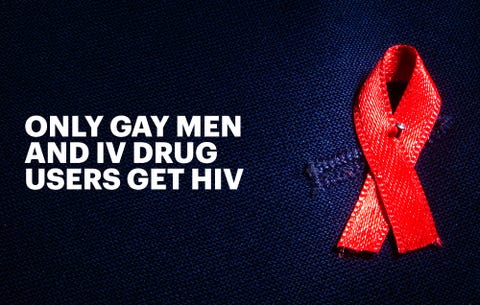
This particular myth is curiously persistent, according to Gabriel Rebick, Grand.D., specializing in infectious disease and immunology at NYU Langone Health.
"I run into a lot of heterosexuals who thought they couldn't go HIV, and that'southward apparently not true," he says.
The risks are higher people who have anal sex, the about transmissive mode to go HIV. That's because the lining of the rectum is thin and can develop micro-tears that permit HIV-infected semen to enter the bloodstream. People who use Iv drugs are also a high-risk group since they can share needles, and fifty-fifty a small-scale amount of blood from i person to the side by side tin cause infection.
But that doesn't mean anybody else is in the clear. In fact, a 2016 study from the CDC institute that heterosexuals accounted for 25 percent of the new HIV cases in 2010. And of the number of new heterosexuals infected in that year, 34 percent of them were men.
Related: 8 Things You Must Know Virtually Anal Sex
HIV Myth: You can tell who has HIV because they will seem sick

One of the most hard aspects of recognizing HIV is the lack of symptoms, which is what has fabricated the epidemic into, well, an epidemic. Yet some people still believe that those with HIV will "seem sick,"—like having flu-like symptoms or lesions—and so having sex with someone who seems perfectly healthy presents no risk. Unfortunately, that'south non the example.
"Especially early on, there'southward rarely an indication of infection," says Dr. Rebick. "That'due south why it's important to go tested if you're sexually active and accept multiple partners, or if you lot're an IV drug user. Or, really, anyone."
The CDC recommends all adults get screened for HIV at to the lowest degree once, and people at higher risk, similar sexually active gay men, at get re-screened at least annually.
Related: 4 STDs You Might Already Have
HIV Myth: Condoms and clean needles are the only way to prevent HIV manual

Yes, those are swell prevention tools. But here's some other wonder of the modern infectious disease era: a drug called Truvada.
This is a pre-exposure prophylaxis (PrEP) handling that comes in the course of a single pill taken daily by people who don't have HIV to help prevent against HIV infection. Information technology works past blocking the HIV virus from attacking the allowed system. It's often used for those who are at substantial adventure of infection, such every bit people in high-hazard groups.
Approved in 2012 by the U.South. Nutrient and Drug Administration (FDA) for PrEP , the drug notwithstanding isn't readily available in some parts of the country, since information technology's taking some time for the regimen to become widely accustomed, says Dr. Malvestutto. But it's widely used in larger urban areas like New York City and San Francisco, and it's been a game changer for HIV prevention.
"With this drug, which is very safety and has minimal to no side furnishings, you lot tin can be exposed to HIV and you lot'll exist protected," he says. "It'south contributing to reducing the take chances of transmission. I accept some patients who've been on it for years." (Still, it won't protect confronting other STDs, so condoms are still needed for that.)
HIV Myth: If you are exposed to HIV, at that place's null y'all tin can practise to prevent infection

There is, actually, a kind of Program B for HIV, and it's a strategy called post-exposure prophylaxis, or PEP.
These are antiretroviral medicines that must be administered within 72 hours—although sooner is meliorate—in the case of potential HIV exposure. You take them for 28 days, and the treatment significantly reduces the risk of infection, co-ordinate to says Dr. Malvestutto.
HIV Myth: You lot can hands get HIV from any exchange of fluids, including oral sex

Nope. HIV is transmitted through blood or semen, only the CDC emphasizes that y'all have "little to no risk" of getting or transmitting HIV from oral sex, considering of the low chances of semen inbound the bloodstream. However, information technology tin occur if there are sores in the oral fissure or penis, or bleeding gums.
The risk is fifty-fifty lower with kissing unless you take some serious glue affliction effect on both sides. But the chances of that happening are incredibly depression. (Hither'southward why your gums bleed after you brush your teeth.)
"This is really one of the biggest misconceptions we hear," says Dr. Rebick. "People think you tin HIV from hugging, or beingness in close contact with someone who has the virus. Some people fifty-fifty recall information technology tin airborne. All of that is merely untrue."
This content is created and maintained by a third party, and imported onto this page to help users provide their email addresses. Yous may exist able to find more information about this and like content at piano.io
Source: https://www.menshealth.com/health/a19539983/hiv-myths-you-should-not-believe/
0 Response to "How to Know Who Gave You Hiv"
Post a Comment